Thursday, 10. April 2008

MySociety: getting involved with politics web 2.0 style


Picture-6

The greatest thing I heard about on re:publica, the German annual blogger´s festival, has got to be MySociety. MySociety is a group of websites from the UK that all aim at getting people involved with local issues and their community. In their own words:

mySociety has two missions. The first is to be a charitable project which builds websites that give people simple, tangible benefits in the civic and community aspects of their lives. The second is to teach the public and voluntary sectors, through demonstration, how to most efficiently use the internet to improve lives.

In oder to achieve that, Tom Steinberg, Francis Irving and Matthew Somerville, the founders of MySociety, have developed sites like FixMyStreet.com and TheyWorkForYou.com.

On FixMyStreet you can report problems in your neighborhood like pot-holes, street light etc. by simply entering your Zip-code and marking the specific area on a map. The report is then sent straight to the council responsible for this area. The site also shows when a reported problem gets fixed. It get´s even better with TheyWorkForYou. On this site you can find all members of parliament (MPs) and all Lords, subscribe to feeds of their activities, browse their last statements, monitor their voting behavior and much more.

I really think this is clever use of the internet and I hope that we get similar sites in Germany and Indonesia soon!

Tuesday, 18. March 2008

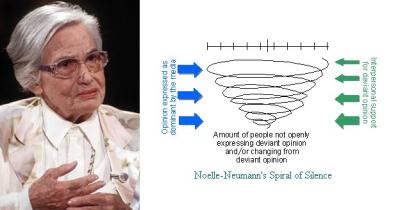
Noelle-Neumann's Spiral of Silence and voicing opinion in the blogosphere


Elisabeth_Noelle-Neumann

I just scanned a paper by Korean researcher Jeong Kim that links the Spiral of Silcence theory to processes in the blogosphere. In short, SoS theory states that individuals with opinions that contradict majority opinion tend to remain silent, while individuals who feel like they are representing the majority tend to speak up.

Jeong Kim asks what this concept means in the realm of blogs where, in contrast to 'big media' such as TV and newspapers, minority opinions can (technically) be easily voiced and interaction is possible on a one-to-one level.

What´s particularly interesting about this paper is the researchers methodology: he asks two (quite prominent) Korean bloggers to act as his informants and to reveal in their blogs two attitudes which are considered to be minority opinions in Korean society: open pro-Americanism and pro-Japanism (?). A rather funny experiment, I believe. it kind of makes me want to try this myself...

Anyway, the paper comes to the conclusion that in the blogosphere, voicing out minority opinions can lead to an (unforeseen) high level of exposure, sometimes leading to the point where the blog author chooses to beomce less visible by closing the blog, moving it, or limiting the visibility of certain posts and comments. Jeong Kim says that blogging is characterized by a 'paradoxical interplay between struggle for and struggle by visibility'. Quite true, isn´t it?!

Thursday, 6. March 2008

COLLECTIVE IDENTITY AND EXPRESSIVE FORMS BY D. SNOW - PART 2


banner_collectiveidentity

I´m finally back with some thoughts on collective identity. Since I am interested in the types of identities that tie together a group/network of bloggers, I thought it might be a nice idea to start off with some basics on the concept of identity in theory.

I chose to quickly sum up an article by David Snow
that provides a nice overview of the conceptualization of identity, especially collective identity, in different scholarly works.

He notes that, at the base of every interaction amongst individuals or groups lies the reciprocal attribution and avowal of identities. Identity is thus a key factor in making social interaction possible.

Conceptualizations of identity differentiate three identity types: personal, social and collective.

Social identities are meanings attributed to others in order to place them in social space, it is similar to the idea of social roles, such as ‘teacher’ or ‘mother’.

Personal identities are the meanings attributed to oneself.

Collective identities are a bit trickier. They overlap with social and personal identity. Snow notes that there is so far no consensual definition of collective identity (CI). However, an essence seems to be a shared sense of “We-ness”- including a sense of shared attributes and experiences and the idea of a contrast or relation to a set of ‘others’ Embedded in the sense of We-ness is the possibility of collective action (for a common cause).

Another common theme that runs through literature is the insistence that CI is a process rather than a fixed property. CI is transient and subject to modification and transformation.

CI can technically emerge among any social group, ranging from small cliques like fanclubs to broad categories such as gender, ethnicity or religion. The majority of research has focused on the last type of groups. Another characteristic is that CI is often studied in the context of social movements.

In the predominant view, CI is a construct, it is invented, not biologically or culturally determined.

There are several points of interest for the study of CI, for example the area of Identity Work, which focuses on how CI is created, expressed, sustained and modified. At the core of this is the study of generation and maintenance of symbolic resources that distinguish the group internally and externally.

Other fields of study are Identity correspondence conflicts, or the types or layers of CI.

Tuesday, 12. February 2008

COLLECTIVE IDENTITY AND EXPRESSIVE FORMS BY D. SNOW - PART 1


banner_collectiveidentity

I will begin this post with a confession: when I started my research, I didn´t have a clear plan laid out, no solid hypothesis to guide me and no neatly packed set of theories in my backpack. I figured I would stumble upon what I need along the way, and kind of adapt my research to what I find. (I hope my professor doesn´t read this.)

However, I am all along driven by the idea that blogging and the concept of identity are closely linked, my little private theory being that blogging is a process of generating collective identity. (Not the 'big' identities that most research on identity focuses on, such as 'being black' or 'being Christian', but rather small, fluctuating identity groups that form and disintegrate as needed)

I´m thinking of...

... collective identities that may begin with the postulation of an identity by and individual (the blog author) which in itself would be a construct of individual identity and cyberidentity

... or with a group of authors who have already for themselves constructed a small collectivity which they wish to stabilize/extend in the blogosphere

... and participating readers who adapt, transform and reproduce this identity through their comments, links and reactions...

... this in the end wil result in a set of shared symbols, memories and thus shared meaning that still has to do with, but is much more than the initial identity the author(s) proposed...

... which CAN have the power to result in shared action, be it online or in 'real space'...

... but could also be the RESULT of a shared action...

... which would bring me to the text by D. Snow which I was going to discuss here in first place! Since it is already late, this wil have to wait until tomorrow.

Thursday, 31. January 2008

MAREN HARTMANN, MY SUPERVISING PROFESSOR


banner_hartmann

I just got back to Germany after a pleasant and informative stay in Jakarta. One of my first visits here was to see Prof. Maren Hartmann who has agreed to supervise my paper.

Maren Hartmann now teaches communication sciences at my uni (University of the Arts, Berlin) with a focus on sociology of communication and new media.

She has published several books and articles on the subject of new media and cyberculture, among these: She has studied and lectured at several universities in the UK and has fortunately also agreed to let me write my paper in English!

About me

me

Born on September 20th, 1979 in Cilegon, a small city close to Jakarta, I spent most of my childhood years Indonesia. After graduating from Jakarta International School in 1997, I moved to Germany. Here, I went from doing a 2 year course in media design to studying communication science and cultural studies the University of the Arts, Berlin. I work as freelance designer, translator, and assistant to Dutch artist IEPE.

contact me here:

mail (at) texastee.de
twitter: texastee

Pesta Blogger 2008: I wish I could be there, but I will follow it from afar.

Pesta Blogger 2008

Users Status

You are not logged in.

Search


Status

Online for 6976 days
Last update: 22. Oct, 23:40

Credits


about this blog
Bandung
facts and figures
interviews
my research
off topic
people and projects
related articles
thoughts and theories
Profil
Logout
Subscribe Weblog